
Comité
Veilige
Opvang
Amsterdam
The problem
Reception centres are often unsafe
© CVOA
For people fleeing threat and violence in their home countries, the large reception centres in the Netherlands are not always safe places to live.
Hundreds of residents — each with their own language, culture, and sometimes religion — live in close quarters for years. They share tiny rooms with strangers, with just a bed and a cabinet to call their own. Major differences and prejudices, years of frustration about slow procedures, uncertain futures, and many relocations breed tensions. These problems will intensify now that the applications of more than 50,000 people who applied for asylum in the Netherlands before June 2026 are projected to suffer delays of up to 11 years.
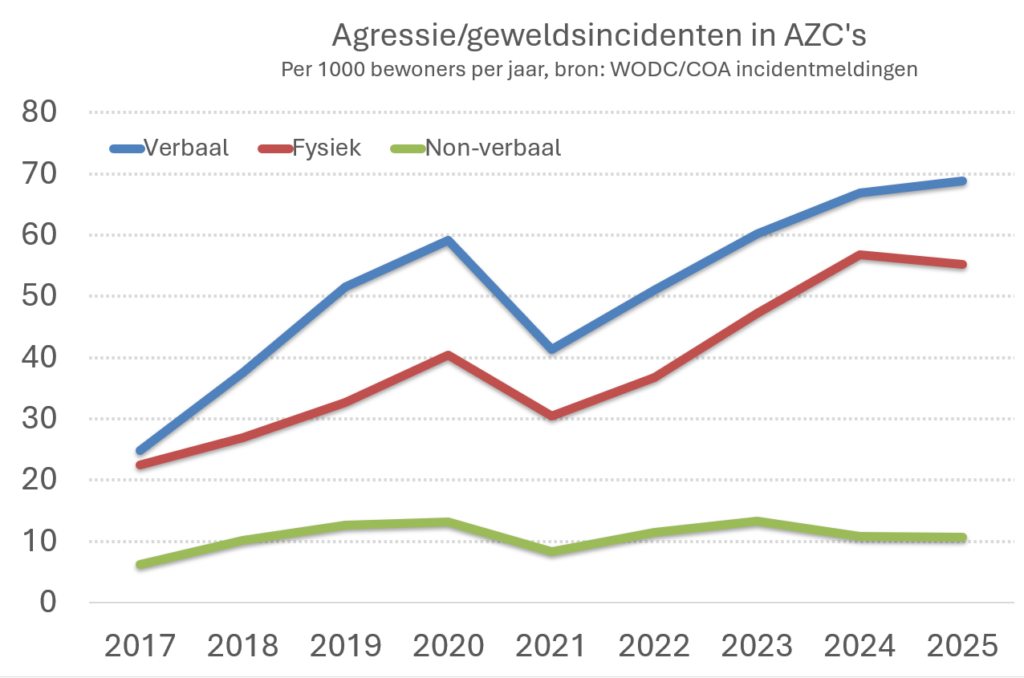
For the last ten years, the Central Agency for the Reception of Asylum Seekers (COA) has been registering reports of “incidents” in reception centres. The number of incidents (per thousand residents) has remained high for years. There are indications that not all incidents are being reported.
Vulnerable refugees
COA does register “incidents” but not who they are directed against. National and international research (see below) show that certain categories of refugees — such as women travelling alone and refugees with a queer (LGBTI) background — are particularly vulnerable.
Standard reception centres are often not a safe environment for young children either, with insufficient opportunities to support their physical, mental and intellectual wellbeing and development.
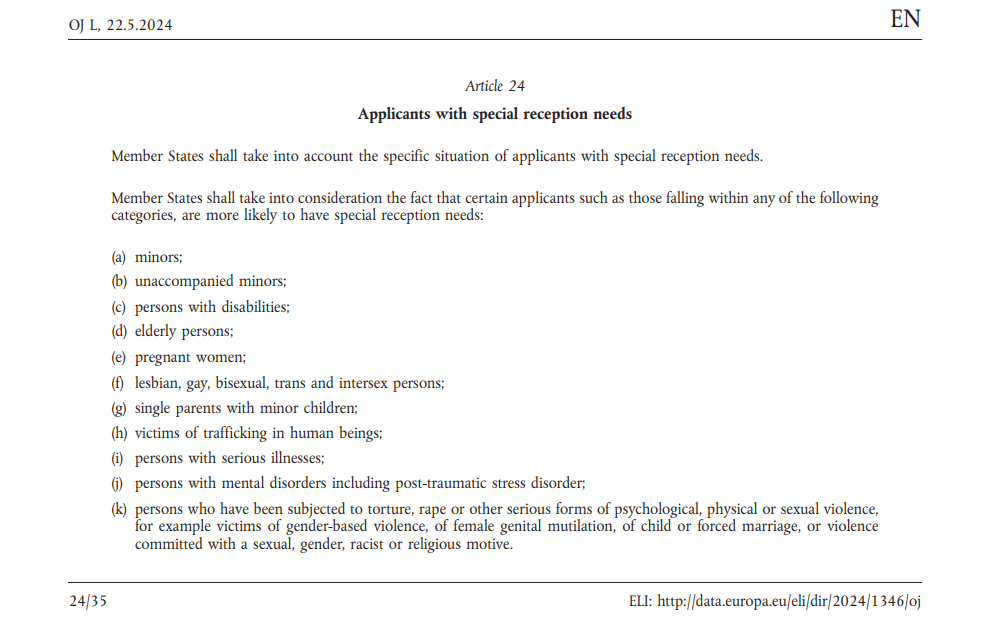
Article 24 of the EU Reception Conditions Directive lists vulnerable refugee categories, including:
- persons with disabilities
- older people
- pregnant women
- lesbian, gay, bisexual, trans and intersex people (LGBTI)
- single parents with minor children
- victims of human trafficking
Research and reports
Since 2011, numerous studies and reports have highlighted the structural and urgent reception needs of vulnerable refugee categories. Here’s a non‑exhaustive selection:
- 2011 | Deloitte — “88% of the [LGBTI or convert-background respondents] did not feel safe in the asylum centre. [..] Many reported hiding their identity and described threats, intimidation, assault, spitting, knife attacks, and destruction of personal belongings.”
- 2013 | COC Netherlands — “22 out of 29 respondents (76%) felt unsafe at COA locations.”
- 2015 | UNHCR — “LGBTI asylum-seekers and refugees are subject to severe social exclusion and violence in countries of asylum by both the host community and the broader asylum-seeker and refugee community.”
- 2015 | COC Netherlands — ‘We advocate for separate, categorical reception for LGBTI asylum seekers who need it. [..] We propose that these measures be taken in addition to the regular efforts aimed at improving safety for LGBTI asylum seekers (such as training COA staff).”
- 2016 | Baker & McKenzie — “Our research finds that LGBT asylum seekers are particularly vulnerable in immigration detention and face significant disadvantages and dangers. In detention they experience discrimination, harassment and violence from other detainees and from members of staff. The detention environment has serious long-term effects on their mental and physical well-being.”
- 2016 | ILGA-Europe — “LGBTI asylum seekers run additional risks and have specific needs in terms of legal assistance and reception conditions. Currently, in most Member States, they have very limited access to such services. Therefore, ILGA-Europe calls on the European Parliament and Member States to ensure that the recast of the Reception Conditions Directive ensures an improvement of the situation of asylum seekers with special reception needs, in particular LGBTI asylum seekers.”
- 2018 | LGBT Asylum Support — “The Keep it Silent study shows that 40% of the 72 participating LGBTI asylum seekers experienced a violent incident in an AZC, 60% of which were directed at them personally. This means that nearly one in four LGBTI asylum seekers is directly confronted with a gender‑related violent offence — and all of this in an environment that is supposed to be safe for vulnerable asylum seekers.”
- 2021 | Vrije Universiteit / Regioplan — “Seven out of ten LGBTQ+ respondents say they often do not feel safe in the asylum centre. Transgender people are identified as particularly vulnerable. […] Sharing a room with fellow asylum seekers who are not tolerant of people with a different sexual orientation or gender identity can create significant tension and lead to bullying and incidents. One strategy used by some asylum seekers is to make themselves as unrecognisable as possible as LGBTQ+.”
- 2024 | LGBT Asylum Support — “In 2024, we sent 830 incident reports to COA (500 in 2022; 75 in 2020).”
- 2023 | Dutch Inspectorates — “Children in asylum reception are not receiving the care, education, and support to which they are entitled. This puts their safety and development at risk. […] Nearly a year after the first urgent warning, the situation for asylum seekers has still not improved.”
- 2024 | Dutch Safety Board — “Specific groups feel unsafe at COA locations. Respondents reported being threatened, intimidated, insulted, beaten, or stabbed by fellow residents. Personal belongings were also sometimes deliberately damaged. […] One obstacle in assessing and placing asylum seekers is that staff are not always aware of (potential) conflicts. People from vulnerable groups do not always report violence, and COA staff do not always know that someone belongs to a vulnerable group.”
- 2024 | Inspectorate of Justice & Security — “The situation has now become so serious that residents and staff face an unacceptable risk of becoming victims of a (violent) incident. We ask you to take additional measures now to improve the safety of residents and staff at the COA location in Ter Apel.”
- 2024 | EU Reception Conditions Directive — “Directive 2013/33/EU laying down standards for the reception of applicants for international protection states: ‘The reception of persons with special reception needs must be a basic priority for national authorities, in order to ensure that the reception provided is tailored to their specific needs. […] Member States shall take into account the specific situation of vulnerable persons in their national legislation implementing this Directive. […] Member States shall ensure that the support provided under this Directive to persons with special reception needs is adapted to those needs throughout the entire asylum procedure, and that their situation is appropriately monitored.’”
- 2025 | COC Netherlands — “Of the 54 [LGBTI] respondents, 50 percent said they regularly felt unsafe, and 20 percent felt unsafe every day. Of those surveyed, 57 percent had personally been confronted with violence and/or discrimination.”
Still no safe reception
Despite many reports and good examples in foreign countries (such as neighbouring Germany), the Netherlands still lacks structural solutions for vulnerable refugee categories. Some locations reserve a few separate units or rooms for families or queer refugees facing acute threats, but this emergency capacity is far below the need shown in research and international practice.
Unlike in other EU countries, refugees registering in the Netherlands are thus far not asked immediately and by default about their vulnerability status or special reception needs, meaning the scale of the need cannot and has so far never been established officially.
Over the years, the Dutch government has given various reasons for not creating safer, separately located reception. These include concerns about stigmatisation, fears that reducing diversity in centres might lower overall safety, ideas about peaceful cohabitation as a lesson on Dutch behavioural norms, worries that dividing residents into groups could reduce public support for new reception centres, and the argument that separate facilities might reduce the flexible use of all the available space.
The Committee for Safe Shelters in Amsterdam considers these arguments insufficient — especially in light of international experience — to justify that the City of Amsterdam would allow structural unsafety of vulnerable asylum seekers to persist. Vulnerable refugees should not be forced to endure threats and violence in order to help manage general challenges in reception capacity.